

What’s Happening at Good Works Auto Repair This Month
Tips, News, Offers, Events & More!
Text NEW10 to 480-894-0018 for 10% off Your First Visit!

OFFERS OF THE MONTH
Black Friday Deals!
Article
Flashing vs. Steady Check Engine Light: What’s the Difference, and Can You Keep Driving?
Stream the New Podcast
Underneath the Hood Podcast
Request an Appointment
Request an appointment at our Tempe, AZ shop


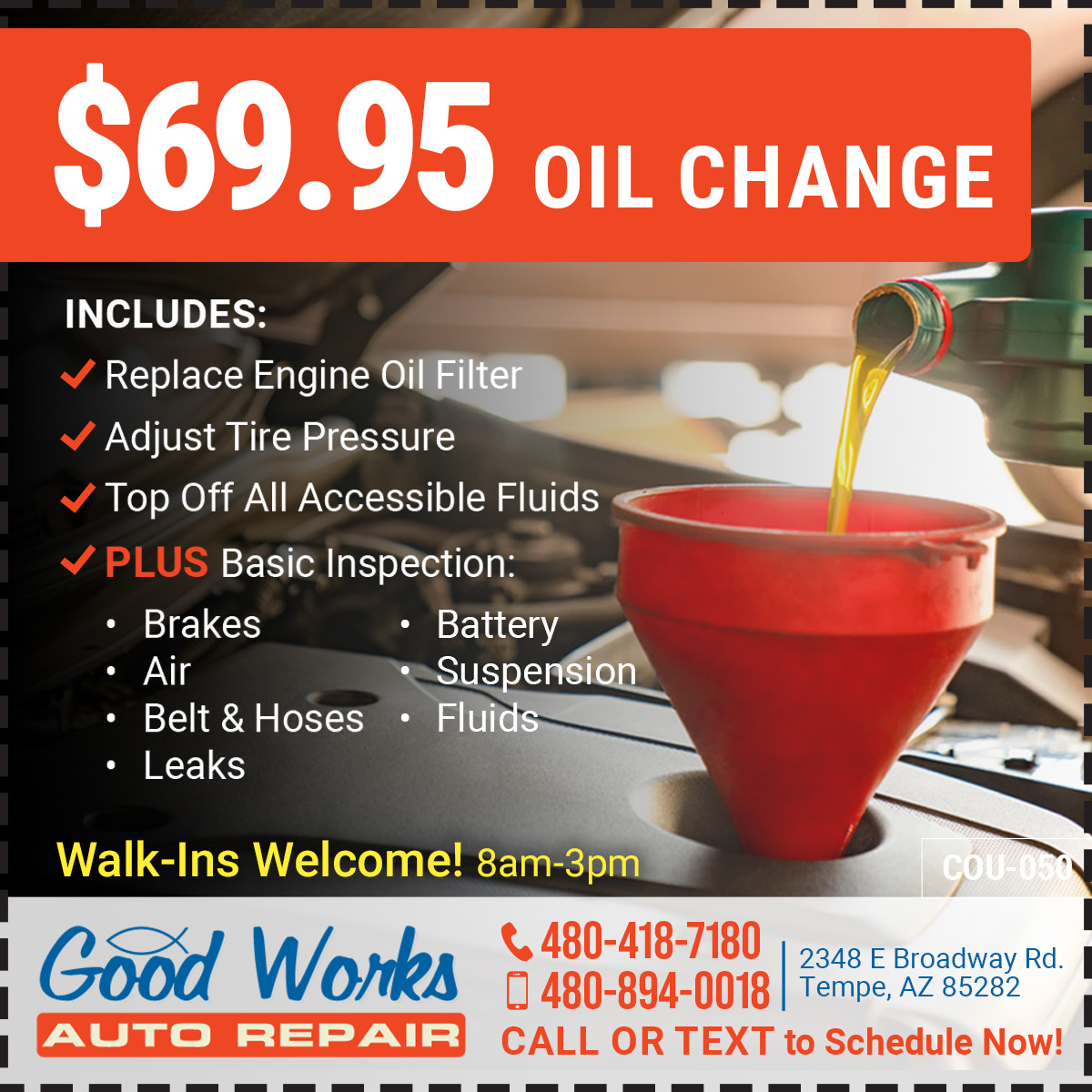
Take advantage of these limited time offers and make an appointment TODAY!
Underneath the Hood Podcast with Glen, Dave, and Lee
In this podcast, you’ll hear about their experiences in the School of Hard Knocks – how they’ve learned what TO do and what NOT to do in an effort to serve people better and grow their businesses. You’ll get an insider’s view of the automotive industry but also learn tips that can be useful for any business that serves people. And as a vehicle owner, you’ll gain a better understanding behind what it takes to bring you the top quality, honest auto repair services you enjoy today.
Listen Now →


Vote for Us in the Best of Arizona Business Awards!

Help Us Shine: Cast Your Vote for Us in the Best of Arizona Business Awards!
If you’ve experienced our top-notch service and found our team to be trustworthy and reliable, please consider sharing your positive experience by casting your vote. It’s quick, easy, and it would mean the world to us.
Your vote not only supports our business but also helps us continue to provide exceptional auto repair services to our community.
Flashing vs. Steady Check Engine Light: What’s the Difference, and Can You Keep Driving?
You’re driving down the road when suddenly, your check engine light comes on. Should you pull over immediately, or can you wait until your next scheduled maintenance appointment?
The answer depends partly on whether the light is flashing or staying on continuously.
Understanding the difference between a flashing vs. steady check engine light can help you make safer decisions, prevent unnecessary engine damage, and avoid expensive repairs.
At Good Works Auto Repair in Tempe, AZ, we help drivers throughout the East Valley understand what their vehicle’s warning lights mean and identify the underlying problems through professional engine diagnostics.
Here’s what you need to know before you keep driving.
Flashing vs. Steady Check Engine Light: What’s the Difference?
The biggest difference between a flashing and steady check engine light is the urgency of the warning. A flashing light typically indicates a more serious problem that requires immediate attention, while a steady light generally means your vehicle has detected an issue that should be diagnosed promptly but may not require you to stop driving immediately.
Here’s a quick comparison:
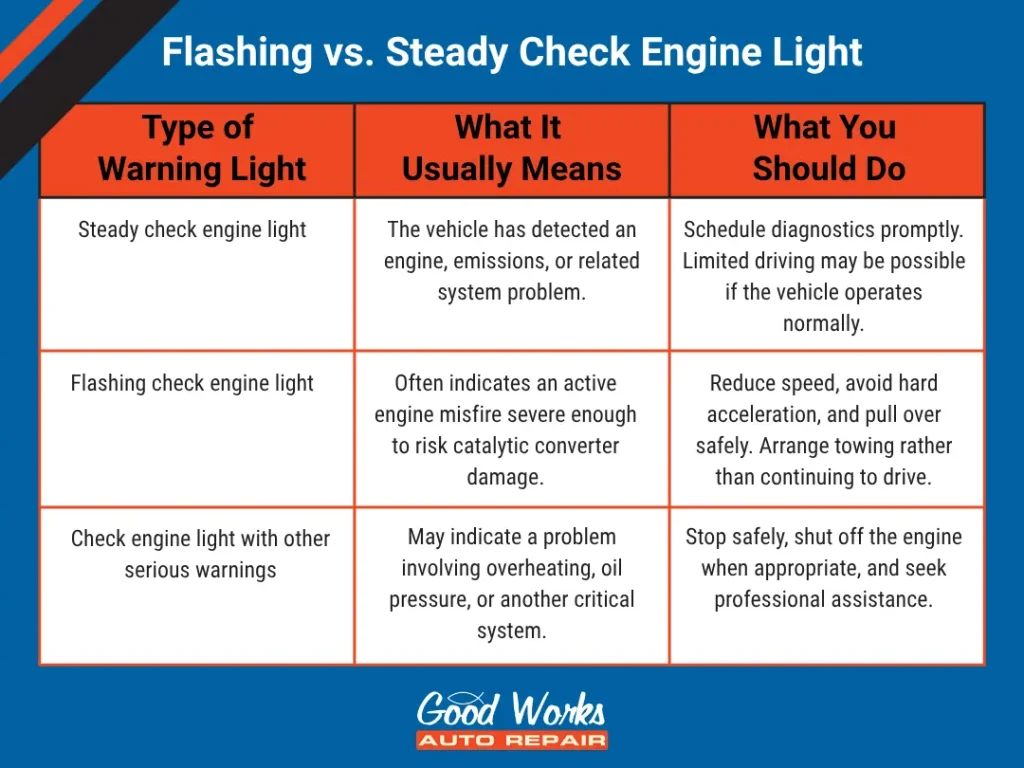
Important: A steady check engine light doesn’t automatically mean your vehicle is safe to drive. Unusual noises, shaking, smoke, overheating, or significant power loss can indicate a serious problem even when the light isn’t flashing.
What Does a Flashing Check Engine Light Mean?
A flashing check engine light is an urgent warning that should never be ignored.
In many gasoline-powered vehicles, a blinking check engine light indicates an engine misfire severe enough to potentially damage the catalytic converter.
An engine misfire occurs when one or more cylinders fail to burn the air-fuel mixture properly. When unburned fuel enters the exhaust system, it can overheat the catalytic converter and cause expensive damage.
Common Causes of a Flashing Check Engine Light
Several problems can cause severe engine misfires, including:
- Worn or faulty spark plugs: Spark plugs that aren’t firing properly can prevent complete combustion.
- Failing ignition coils: A malfunctioning ignition coil may not deliver sufficient voltage to ignite the air-fuel mixture.
- Fuel injector problems: A clogged, leaking, or malfunctioning injector can disrupt fuel delivery.
- Engine vacuum or intake leaks: Unmetered air entering the engine can create an improper air-fuel mixture.
- Fuel delivery problems: Inadequate fuel pressure or other fuel system issues may cause misfires.
- Internal engine problems: Low compression, valve problems, or other mechanical failures can interfere with combustion.
Although misfires are a common reason for a flashing check engine light, the exact meaning can vary by vehicle. A professional diagnosis is necessary to identify the cause.
Can You Drive With a Flashing Check Engine Light?
You should not continue driving with a flashing check engine light.
Even if your vehicle seems to run normally, continuing to drive could cause additional damage.
If your check engine light starts flashing:
- Reduce your speed and avoid sudden acceleration.
- Find a safe place to pull over as soon as possible.
- Turn off the engine once you’re safely stopped.
- Arrange for roadside assistance or towing to a qualified auto repair shop.
If the engine is shaking, losing power, or making unusual noises, it’s especially important to avoid further operation.
A tow may seem inconvenient, but it could prevent a relatively manageable ignition or fuel system problem from turning into a much more expensive engine or catalytic converter repair.
What Does a Steady Check Engine Light Mean?
A steady check engine light means your vehicle’s onboard diagnostic system has detected a problem affecting the engine, emissions system, or another monitored component.
Unlike a flashing warning, a steady light doesn’t necessarily indicate an immediate emergency.
However, it does mean something needs attention.
Common Causes of a Steady Check Engine Light
Some of the most common reasons a check engine light stays on include:
1. Loose or damaged gas cap
A loose, missing, or damaged gas cap can interfere with the evaporative emissions system on vehicles equipped with a conventional fuel cap.
Sometimes, tightening the cap resolves the underlying issue, although the warning light may take several driving cycles to turn off.
2. Faulty oxygen sensor
Oxygen sensors help the engine computer monitor exhaust oxygen levels and adjust fuel delivery.
A sensor problem can affect fuel efficiency, emissions, and engine performance. However, an oxygen sensor-related trouble code doesn’t always mean the sensor itself has failed.
3. Catalytic converter problems
Your catalytic converter helps reduce harmful exhaust emissions.
A steady check engine light may indicate that the catalytic converter isn’t operating efficiently. The underlying cause could involve the converter itself or another issue, such as an exhaust leak or improper fuel mixture.
4. Mass airflow sensor problems
The mass airflow sensor measures the amount of air entering the engine.
Incorrect readings can affect fuel delivery, engine performance, and fuel economy.
5. Evaporative emissions system leaks
Your vehicle’s evaporative emissions system helps prevent fuel vapors from escaping into the atmosphere.
Leaks, faulty valves, and other system problems can trigger the check engine light.
6. Engine misfires
Not every misfire causes a flashing check engine light.
Less severe or intermittent misfires may trigger a steady warning. These problems still deserve prompt attention because they can worsen over time.
Can You Keep Driving With a Steady Check Engine Light?
In some situations, yes — but only cautiously and for a limited period.
If your check engine light is steady and your vehicle is otherwise operating normally, you may be able to drive a short distance to a repair shop.
Before continuing, consider these questions:
- Is the engine running smoothly?
- Is the vehicle accelerating normally?
- Is the temperature gauge within its normal range?
- Are there any unusual noises, smells, or vibrations?
- Are there additional warning lights illuminated?
If everything appears normal, schedule an engine diagnostic appointment as soon as practical.
However, if your vehicle is overheating, running roughly, losing significant power, or displaying an oil pressure warning, stop driving as soon as it’s safe.
Don’t assume that a steady check engine light means the problem can wait for weeks or months. Small problems can become more serious when left unresolved.
Why You Shouldn’t Ignore a Check Engine Light — Even If Your Car Runs Fine
One of the most common questions drivers ask is:
“My check engine light is on, but my car drives fine. Do I really need to get it checked?”
The answer is yes.
Many engine and emissions problems develop gradually. Your vehicle’s computer may detect an issue long before you notice a change in performance.
Ignoring the warning could lead to:
- Reduced fuel efficiency
- Increased exhaust emissions
- Poor engine performance
- Catalytic converter damage
- Failed emissions testing
- More expensive repairs later
For drivers in Tempe and surrounding East Valley communities, Arizona’s extreme summer heat can add stress to vehicle components. Maintaining a properly functioning engine and cooling system is particularly important during hot weather.
Getting the warning light diagnosed early can help you avoid unnecessary complications.
Does a Check Engine Light Code Tell You Exactly What’s Wrong?
Not necessarily — and this is one of the biggest misconceptions about check engine light diagnostics.
When your check engine light comes on, your vehicle’s onboard diagnostic system typically stores one or more diagnostic trouble codes (DTCs).
A code reader or scan tool can retrieve those codes, but the codes don’t always identify the specific component that needs replacement.
Instead, they often tell a technician which system has detected an abnormal condition.
Example: What Does Code P0301 Mean?
Let’s say a scan tool retrieves diagnostic trouble code P0301, which indicates a misfire detected in cylinder 1.
That code tells us where the misfire was detected, but it doesn’t explain why it happened.
Possible causes include:
- A worn spark plug
- A failing ignition coil
- A malfunctioning fuel injector
- A vacuum leak
- Low cylinder compression
- A wiring or electrical problem
Replacing the spark plug without further testing might solve the problem — or it might not.
The takeaway: A diagnostic trouble code is a starting point for troubleshooting, not a guaranteed diagnosis.
That’s why professional engine diagnostics involve more than simply plugging in a scanner and reading a code.
What Happens During Professional Check Engine Light Diagnostics?
At Good Works Auto Repair, our goal is to identify the underlying cause of your vehicle’s problem so we can recommend the appropriate repair.
Depending on your vehicle’s symptoms and the codes present, professional engine diagnostics may include:
1. Retrieving Diagnostic Trouble Codes
A technician uses professional diagnostic equipment to retrieve stored and pending trouble codes and review relevant vehicle information.
2. Reviewing Live Vehicle Data
Modern diagnostic tools allow technicians to evaluate information from sensors and engine control systems while the vehicle operates.
This data can help identify abnormal readings and narrow down possible causes.
3. Inspecting Related Components
Depending on the problem, the technician may inspect ignition components, fuel delivery systems, wiring, sensors, vacuum lines, or emissions equipment.
4. Performing Additional Tests
Further testing might include electrical circuit checks, fuel pressure measurements, smoke testing for leaks, or engine compression testing.
The appropriate tests depend on the symptoms and initial diagnostic findings.
5. Recommending the Appropriate Repair
Once the problem has been identified, the technician can explain the findings and recommend the next steps.
At Good Works Auto Repair, we believe in a simple philosophy: We advise; you decide.
Our team helps you understand what’s happening with your vehicle so you can make informed decisions about repairs.
Can a Check Engine Light Cause You to Fail an Arizona Emissions Test?
Yes. An illuminated check engine light can prevent your vehicle from passing an emissions inspection.
In the Phoenix metropolitan area, including Tempe, many vehicles are subject to Arizona emissions testing requirements.
For vehicles undergoing an onboard diagnostic (OBD) emissions inspection, an illuminated malfunction indicator light generally results in a failed test.
Even if your car appears to drive normally, a malfunction involving the engine or emissions system can affect your ability to pass.
Why Clearing the Code Isn’t the Solution
Some drivers attempt to turn off the check engine light by clearing diagnostic trouble codes or disconnecting the battery before an emissions test.
Unfortunately, this doesn’t repair the underlying problem.
Clearing codes can also reset emissions readiness monitors. If those monitors haven’t completed their required checks, the vehicle may be rejected or fail the inspection process.
The better approach is to identify and repair the problem, then verify that the vehicle’s emissions monitoring systems are functioning correctly.
Can You Turn Off a Check Engine Light Without Fixing the Problem?
You may be able to clear the light using a scan tool, but that doesn’t mean the problem is resolved.
If the underlying issue remains, the warning light will often return after the vehicle’s computer detects the problem again.
Clearing codes can also erase useful diagnostic information that helps technicians determine what went wrong.
For this reason, it’s generally best to have the vehicle diagnosed before clearing any stored codes.
In some cases, a check engine light may turn off on its own when the vehicle’s computer no longer detects the problem. However, intermittent issues can still require attention.
How to Help Prevent Check Engine Light Problems
Not every check engine light can be prevented, but routine vehicle maintenance can reduce the likelihood of certain engine and emissions problems.
Here are several ways to help keep your vehicle running properly:
- Follow your manufacturer’s maintenance schedule. Replace spark plugs, filters, fluids, and other maintenance items at the recommended intervals.
- Pay attention to changes in performance. Rough idling, hesitation, unusual fuel consumption, or difficulty starting may indicate a developing problem.
- Address small problems early. Minor ignition, fuel system, and emissions issues can sometimes lead to more expensive repairs if ignored.
- Keep up with regular inspections. Professional vehicle inspections can help identify worn components, leaks, and other potential concerns.
- Don’t ignore other dashboard warnings. Temperature, oil pressure, charging system, and other warning lights may indicate problems requiring immediate attention.
Routine preventive maintenance and auto repair can help keep your vehicle dependable throughout the year.
Appointment Request
New customers get 10% OFF labor for your first visit (up to $50.00)! Some restrictions apply. Call us at 480-894-0018 or click the button below to fill our online scheduling form.
Thank you for your interest in Good Works Auto Repair. We value your business and would like to extend some very special savings to our customers. Please visit our Coupons page for special online savings.
Call
480-894-0018
Text
480-894-0018
Shop Hours
Monday – Friday
7:30 am – 5:30 pm
Saturday – Sunday
CLOSED
Our Location
2348 E. Broadway Road
Tempe, AZ 85282
Located at
2348 E. Broadway Rd in Tempe
(Broadway Rd & the 101)
Conveniently located in Tempe near Mesa, Gilbert, Chandler and Scottsdale, our facility is less than a mile away from the Light Rail Station at Price Freeway and Apache Boulevard.
